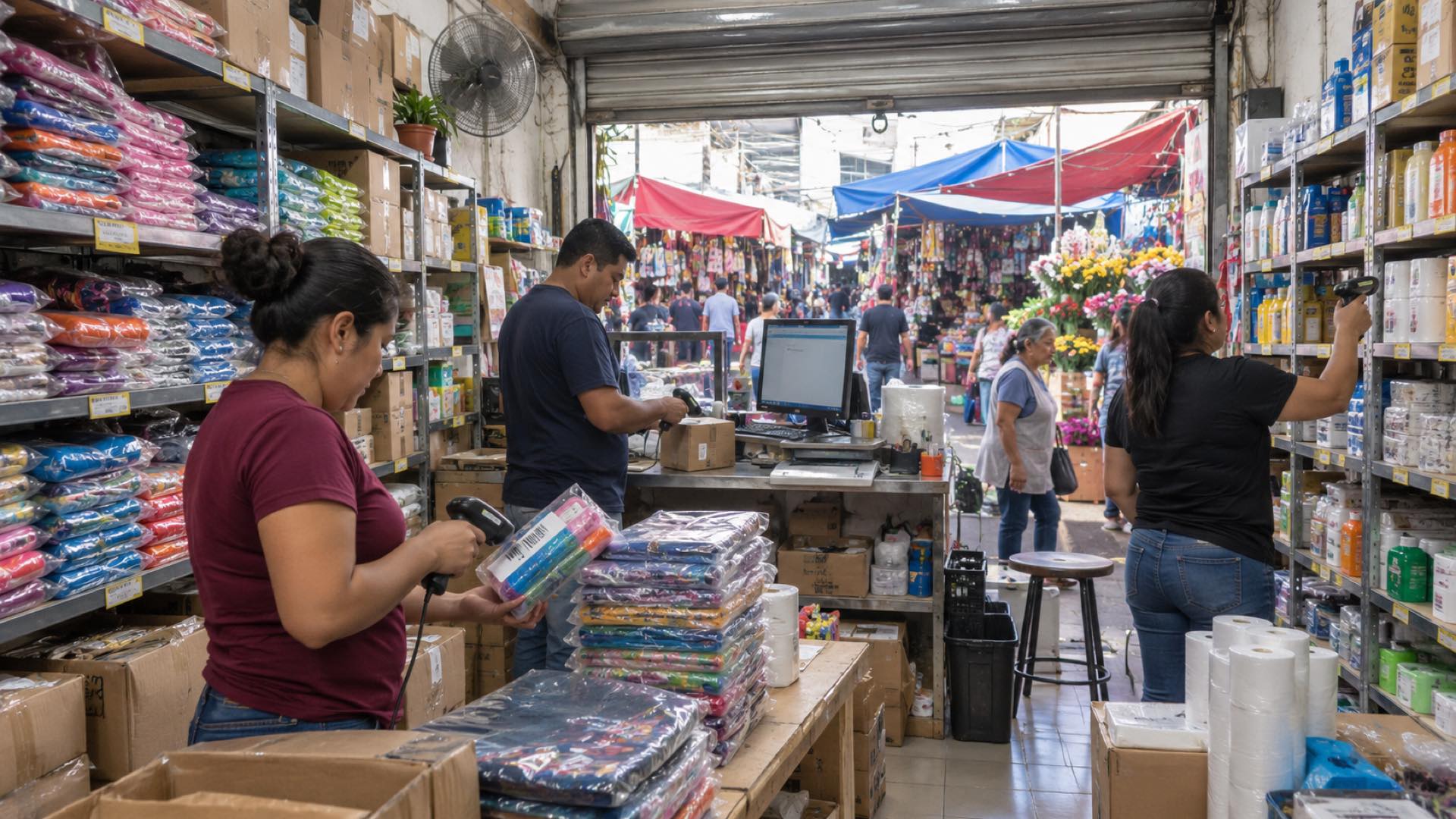
Year-end inventory day, Boss Chen spent two full days squatting in his warehouse at Dong Xuan Market in Hanoi.
His clothing wholesale shop had 3 warehouses, over 1,200 SKUs, from T-shirts to jackets, from children's wear to women's clothing, piled up like mountains. When the inventory results came out, he was stunned: the books showed 8,500 pieces, but the actual count was only 7,200 pieces, a shortage of 1,300 pieces.
"Impossible," he flipped through the densely written Excel spreadsheet, "last month's inventory was only off by 200 pieces, how did it suddenly get this bad?"
What he didn't know was that this 1,300-piece gap didn't accumulate in one day. Over the past 11 months, every purchase, shipment, and return was handwritten by employees, then entered into Excel at night. Sometimes when busy, 50 pieces went out during the day but weren't recorded at night; sometimes the wrong size was entered, M recorded as L; sometimes returns weren't updated in time, so the books kept growing while actual stock kept shrinking.
The error rate climbed from 5% at the start of the year to 15%.
Boss Chen wasn't without solutions. He tried having employees reconcile accounts daily, but with 3 warehouses and 1,200 SKUs, daily reconciliation took 4 hours. Employees complained, and efficiency dropped further. He tried weekly inventory, but everything was messed up again the next day.
"It's not that I don't want to manage inventory well," he said, "it's that I simply can't keep up."
Three Fatal Problems with Manual Inventory
Boss Chen's predicament isn't unique. In Southeast Asian wholesale markets, 90% of clothing wholesalers still use Excel or paper documents to manage inventory. This approach has three fatal problems:
First, data delay. Daytime incoming and outgoing goods aren't entered into the system until night, meaning the "real-time inventory" you see is actually yesterday's data. A customer calls asking, "Do you still have 500 white T-shirts?" You say yes, but the warehouse only has 300 pieces, and the other 200 went out that morning but haven't been recorded yet.
Second, human error. Handwritten documents are easy to misread, write incorrectly, or enter wrong. M and L sizes look similar, 0 and 6 are easily confused, and writing "100" as "1000" has happened. In Boss Chen's warehouse, 3 employees handle data entry, each with different handwriting, sometimes even they can't read their own writing.
Third, no traceability. When inventory reveals discrepancies, it's hard to know where the problem lies. Did the supplier short the shipment? Did we over-ship? Did returns not get recorded? Or were items stolen? Manual records have no timestamps, no operator logs, no before-and-after comparisons. You can only guess.
"What I dread most is inventory," Boss Chen said. "Every time feels like opening a mystery box, never knowing how much will be off."
The Turning Point: From "Close Enough" to "Must Be Precise"
The final order that broke Boss Chen came from a long-time customer.
This customer had 5 retail stores in Ho Chi Minh City, ordering 20,000 pieces monthly from Boss Chen. One day, he ordered 1,000 black jackets. Boss Chen checked Excel, which showed 1,200 pieces, so he accepted the order.
When shipping, the warehouse only had 600 pieces.
"Where are the other 600 pieces?" the customer asked.
Boss Chen went through all the documents and discovered: 3 days earlier, another customer had ordered 500 pieces, but the paperwork hadn't been entered into Excel yet.
The customer was angry: "How can I trust you with my business like this?"
The order only shipped 600 pieces, and the customer said they'd consider switching suppliers. Boss Chen knew that if he didn't solve this problem, he'd lose more customers.
"I didn't sleep all night," he said. "I thought, either keep going with 'close enough,' or find a way to solve this completely."
He chose the latter.
The Solution: Three Key Features of a Barcode Inventory System
Boss Chen started researching inventory management systems. His requirements were clear:
- Real-time synchronization: Daytime incoming and outgoing goods must be reflected in the system immediately, not wait until night
- Barcode scanning: Employees don't write documents by hand, just scan to record, reducing human error
- Traceability: Every incoming and outgoing transaction must have timestamps and operator records, so problems can be traced
He tried several systems and finally chose Ailit. The reasons were simple:
First, it supports both Chinese and Vietnamese bilingual. Boss Chen is a Vietnamese Chinese, and among his 8 employees, 3 only speak Vietnamese and 5 only speak Chinese. Ailit's interface can switch languages, so everyone can operate in their familiar language.
Second, the barcode scanning function is simple and easy to use. Employees don't need much training. Pick up the scanner, scan the product barcode, select "incoming" or "outgoing," and the system automatically records time, quantity, and operator. Boss Chen said: "I taught them for half a day, and they all got it."
Third, real-time inventory synchronization. Inventory data from 3 warehouses syncs to the cloud in real time. Boss Chen can see real-time inventory for each warehouse on his mobile app. "Before, I had to call 3 warehouses to know how much stock we had. Now I just open my phone and know."
Implementation Process: Four Steps from 0 to 1
Boss Chen's implementation took 2 weeks, divided into 4 steps:
Step 1: Product Barcoding (3 days)
He put barcode labels on all 1,200 SKUs. Some products already had manufacturer barcodes, which he used directly; others didn't, so he generated internal barcodes using Ailit. "These 3 days were the most tiring," he said, "but sharpening your axe doesn't delay your woodcutting."
Step 2: Initial Inventory Entry (2 days)
He conducted a full inventory count and entered all actual stock into Ailit. "This is the baseline," he said. "From here on, every incoming and outgoing transaction must be scanned."
Step 3: Employee Training (2 days)
He trained all 8 employees, teaching them how to use scanners and how to process incoming, outgoing, and returns in Ailit. "The hardest part was getting them into the habit," he said. "Before, they could write documents however they wanted. Now they have to scan, and they found it troublesome. But I persisted for two weeks, and they got used to it."
Step 4: Process Optimization (ongoing)
He found some processes needed adjustment. For example, returns used to be handwritten documents, now they need scanning; shipping used to be ship first, record later, now it's scan first, ship later. "The process changed, but efficiency actually improved," he said.
Results: Error Rate Dropped from 15% to 3%
Three months after implementation, Boss Chen conducted an inventory count.
The result surprised him: the books showed 8,500 pieces, actual count was 8,250 pieces, only 250 pieces off, an error rate of 3%.
"From 15% to 3%, an 80% reduction," he said. "I couldn't believe it."
He analyzed the 250-piece gap and found two main causes:
- Supplier short shipments: 150 pieces were short from suppliers during delivery, but previously unnoticed. Now barcode scanning at incoming immediately catches this
- Returns not recorded in time: 100 pieces were returns not yet entered into the system, but this is easy to track
"Before, when we were off by 1,300 pieces, I had no idea where the problem was," he said. "Now we're off by 250 pieces, and I can trace the source of every single one."
Besides the error rate dropping, he noticed other changes:
- Improved customer satisfaction: The customer who almost left came back because he can now accurately tell customers "how much stock we have"
- Increased employee efficiency: Daily reconciliation used to take 4 hours, now only 30 minutes
- Better-informed decisions: He can clearly see which products sell fast and which sell slow, making restocking more targeted
Lessons Learned: Three Replicable Key Points
Boss Chen's success wasn't accidental. He summarized three replicable key points:
First, leadership must be committed to driving change. "If I myself think 'close enough is fine,' employees won't take it seriously either," he said. "I must persist, then they will persist."
Second, processes must be simple and easy to understand. "Scanning is simpler than handwriting, so employees are willing to use it," he said. "If it's too complex, they'll find excuses not to use it."
Third, data must be visible in real time. "Before, I couldn't see real-time data. Now I can," he said. "Only when you can see it can you manage it well."
He now does monthly inventory counts, with the error rate stable at around 3%. "I won't claim 100% accuracy," he said, "but at least I know where the problems are, can track them, and can improve."
Ailit's Position in Inventory Management
Ailit is the international version of Kingdee Wisdom Record, targeting small and medium overseas merchants who do both wholesale and retail. It supports barcode scanning for incoming and outgoing, real-time inventory synchronization, multi-language interfaces, and every operation has timestamps and operator records for traceability.
For clothing wholesalers like Boss Chen with multiple warehouses and employees, Ailit's value lies in: turning "close enough" into "precise and traceable."
But Ailit isn't the only choice. If your business only has one or two SKUs, one warehouse, one employee, Excel might be enough. Ailit's value is: when your business becomes too complex for Excel to handle, it helps you achieve precise, real-time, traceable inventory management.
Frequently Asked Questions
What kind of businesses is a barcode inventory system suitable for?
If your business has over 100 SKUs, more than 2 warehouses, more than 3 employees, and frequently faces issues like inaccurate inventory, difficult reconciliation, or customer complaints about "out of stock," then a barcode inventory system is right for you. If your business is very simple, Excel might suffice.
How long does it take to implement a barcode inventory system?
Generally, 2 to 4 weeks to complete implementation. This includes product barcoding (3 to 5 days), initial inventory entry (1 to 2 days), employee training (2 to 3 days), and process optimization (ongoing). The hardest part is getting employees into the habit of scanning, which usually takes 2 weeks of persistence.
How much can a barcode inventory system reduce errors?
According to Boss Chen's experience, the error rate can drop from 15% to around 3%, an 80% reduction. But specific results depend on your implementation quality: whether product barcoding is complete, whether employees strictly follow scanning procedures, and whether regular inventory calibration is performed.
What languages does Ailit support?
Ailit supports over 10 languages including Chinese (Simplified and Traditional), English, Vietnamese, Thai, Indonesian, and more. Each employee can operate in their familiar language, while the boss can view reports in Chinese.