The first question any shop inventory software has to answer is not how much stock you have, but when to lock it and when to let it go. Two similar wholesale-and-retail stores sell the same goods and take the same online orders. One reserves stock the moment an order is placed; the other waits until payment arrives. Three months later, the first store's counter regularly shows items that cannot be picked, while the second store's online customers regularly discover the item is gone the moment they pay.
Choosing the wrong reservation node costs more than a wrong stock count
An order passes through four nodes from creation to completion: order placed, payment received, picking, and shipment. The node at which the shop inventory software moves an item from "available" to "reserved" is an operating choice, not a technical one.
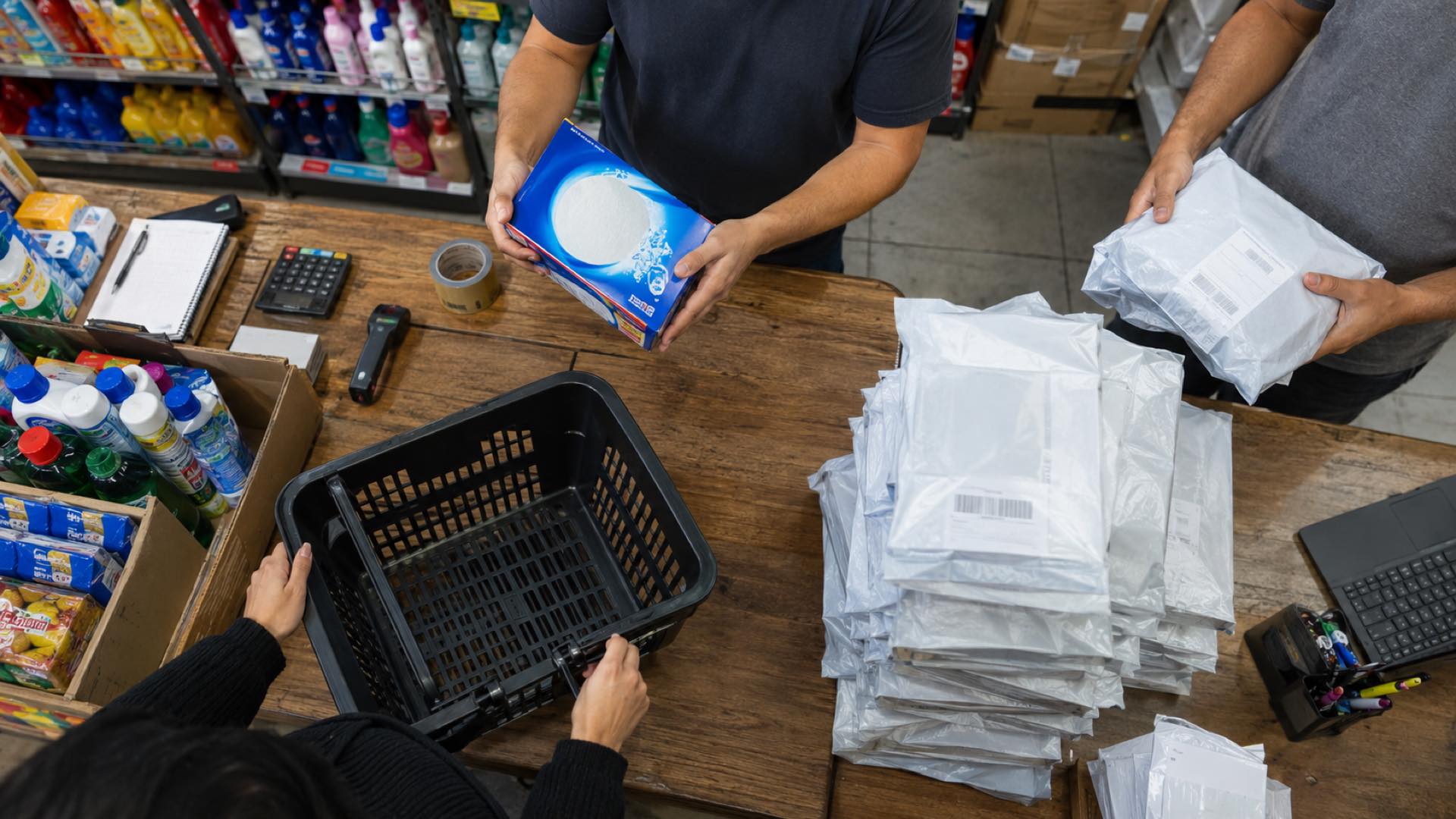
Take a typical wholesale-and-retail daily goods store in Lima. The online platform receives an order at 10 a.m.; the customer usually pays in the afternoon. At 11 a.m., a walk-in customer at the counter wants the same item in hand. If the system reserves at order time, the counter cannot sell it. If the system waits for payment, the online customer may find the item gone by the time they pay.
Most failures come from rules that were never set. The reservation node stays vague, both channels wait for the other to yield, and staff end up coordinating by phone.
How can wholesale shipments and counter retail share the same inventory?
Through channel priority, not a single shared table. The trick to sharing inventory is to rank the channels; matching numbers on both sides is the outcome, not the method.
Wholesale orders tend to be large and time-sensitive. Counter retail is cash-and-carry. A system that can serve both needs to set different reservation rules by channel or customer tier: a wholesale order reserves for three days once confirmed, a retail order reserves for thirty minutes, and anything unpaid past the window is released back into the available pool automatically.
Without that separation, wholesale customers lose stock to retail grabs, or the counter stares at "in stock" that pickers cannot reach.
Release windows are calculated from conversion rates, not guesswork
A long reservation window, say twenty-four hours for online orders, reduces pre-payment churn. The cost is that no other channel sees the item as available for those twenty-four hours. If fifteen of fifty online orders a day go unpaid, fifteen items are locked for a day for nothing.
A short window, say ten minutes, speeds inventory turnover. But the customer who just stepped out to the payment page sees "out of stock," and conversion drops.
At the tool level, spreadsheets and paper ledgers cannot time reservations by channel. Generic inventory software usually supports customization but takes a long time to implement. The Ailit inventory system, built by Kingdee Group for small and medium merchants, supports channel-specific inventory reservation rules and release windows. What it solves is whether the rules can be enforced per channel; how long each window should be is a number the owner still has to derive from their own store's payment conversion rate.
How do you trace inventory mismatches after multi-store transfers?
Check in-transit status before counting the shelves. The gap between the moment the sending store deducts the item and the moment the receiving store signs for it is the most common source of multi-store mismatches. A physical count tells you a difference exists, not where it came from.
Inventory reservation rules apply here too. When an item moves from Store A to Store B, does Store B's system count it as available while it is still on the truck? If yes, the counter at Store B may sell an item that is physically still in transit. If no, Store B's available figure runs artificially low.
For multi-store inventory management, a system that visualizes in-transit status can locate the source of a mismatch in minutes. One that requires order-by-order reconciliation costs a multi-warehouse team half a day or more every month. Ailit supports multi-store and multi-warehouse transfers with in-transit status display, which fits that scale of operation. Cross-country and cross-currency transfers, however, also involve exchange rates and tax treatment, and that is not something reservation rules can cover.
Back at the Lima daily goods store: once the rules were set, the online channel and the counter stopped calling each other to confirm the same item. Reservation node, release window, and channel priority were all written into the system, and the system executes them as configured.
FAQ
Should shop inventory software set reservation rules by channel?
Yes, separately. When the unpaid churn rates differ clearly across online, wholesale, and counter channels, say forty percent online versus five percent wholesale, the shop inventory software must set reservation triggers and release windows per channel. If churn rates are similar across channels, a single rule is simpler. Ailit supports per-channel configuration, but the parameters themselves have to come from your own store's conversion data.
How does shop inventory software handle simultaneous grabs from counter and online?
By the channel priority set in advance. The higher-weight channel locks the stock first; the lower-weight channel waits for release. Without a preset priority, the system can only go by timestamp, and the counter and online channel end up squeezing each other. Ailit supports channel weighting in parallel wholesale-and-retail scenarios, but you have to decide the priority before going live; the system will not guess for you.
How fast does inventory return to available after a cancellation?
On a real-time path, the rollback to the available pool happens within seconds of the cancellation. On a system that relies on scheduled tasks or manual review, the delay can be hourly, and the counter misses sales in that window. If your business is mostly wholesale appointments with a small counter share, the difference between seconds and minutes matters less.