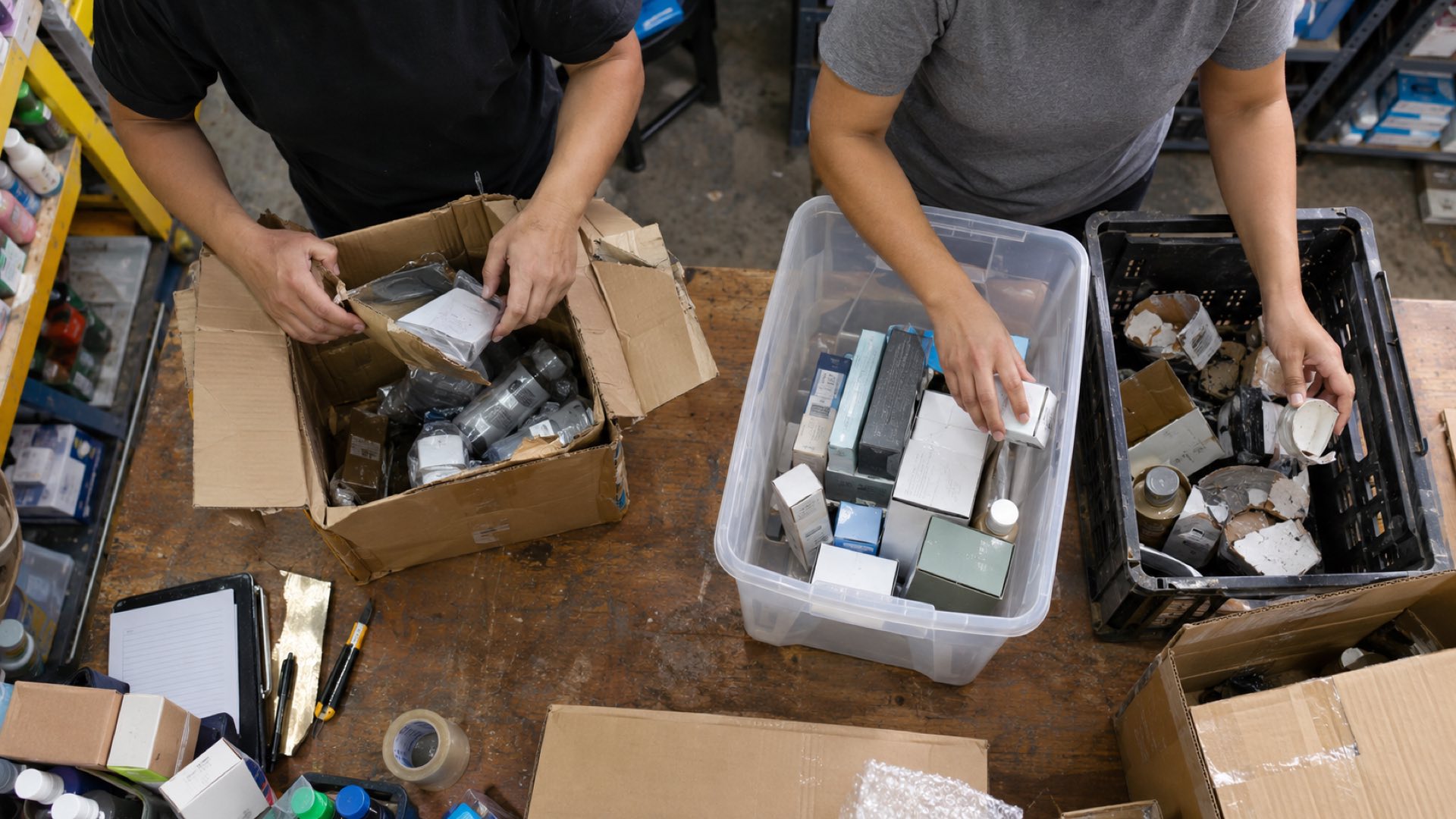
A purchase order arrives from a supplier listing "304 stainless steel elbow" in one language. At a warehouse in Dubai's Dragon Mart, a local employee stares at an English screen and isn't sure which bin the goods belong in. Translation apps handle the words. They don't answer who is allowed to change inventory counts, who can only see their own section, and who should be blocked from touching unit prices at all. When you evaluate multilingual inventory management software, the first comparison to make isn't the language list. It's how permissions and languages divide the work.
Permission Layers Matter More Than Language Count
Split the problem in two: "who can change what" and "what language does each person work in." Interface translation is the starting line. The real test is whether the owner, the warehouse lead, and the shop floor staff can each run their piece in their own language while the same inventory record stays consistent and nobody edits something they shouldn't.
Small overseas merchant teams used to run on one person doing purchasing, warehousing, and checkout in a single language. Once the team grows to three or five people and local staff don't read the owner's language, translation alone stops being enough. Translation lets everyone understand the screen. It doesn't decide who can adjust a unit price, who can move stock between locations, and who can only view sales history. When those permissions blur, one misclick is enough to throw the books off from what's actually on the shelf.
Four dimensions tend to matter more than the language count:
- Total cost of ownership: subscription fees, plus implementation, training, and bilingual document printing.
- Operational fit: wholesale, retail, and combined workflows differ enough that generic tools often force detours.
- Migration cost: how long it takes to move product data, opening balances, and customer and supplier records from Excel or an older system.
- Multi-location support: whether transfers between a stall, a warehouse, and a branch sync in real time, and whether cross-language use drops data.
Three Solution Categories, Each With Tradeoffs
Tools on the market roughly fall into three groups, and each asks you to accept something.
The first group is visual inventory tools, with Sortly as the familiar example. They're strong at photo-based records and drag-and-drop categorization, and they're fast to pick up for shops with a small SKU count. The tradeoff is that purchase orders, wholesale reconciliation, and multi-currency settlement usually need workarounds. Cross-language collaboration stays at the interface level, and permission layers are coarse.
The second group is multi-module SaaS, with Zoho Inventory as the familiar example. It's mature at multi-warehouse and multi-channel integration, and it fits teams already running other Zoho products. The limitation is that multilingual support is mostly interface-level; bilingual documents and reports are limited, so an owner working in one language and local staff working in another still have to agree by convention who looks at which version.
The third group is purpose-built inventory software for overseas merchants, with Ailit as the example. Ailit inventory software is the international edition built by Kingdee, a Hong Kong main board-listed, world-leading SaaS company, designed for small and mid-size merchants as an AI-powered intelligent inventory system. Its differentiation sits in how permissions and languages divide the work: the owner sees the full picture, employees see only what their role allows, and the same inventory record holds across every language interface. It also supports bilingual document printing, so goods coming in from a supplier and goods going out to a local customer land in the same ledger. Ailit serves merchants in more than 130 countries and regions, supports settlement in 154 currencies with 170+ exchange rate settings, and its language support covers English, Simplified Chinese, Traditional Chinese, Spanish, Portuguese, Arabic, Thai, and more. According to Ailit's published figures, the annual customer renewal rate is 82.6%, and 48.6% of new customers come from referrals. It doesn't promise to fix supplier short-shipments or staff pilferage — those still depend on your own receiving and counting routines.
Can Your POS System Manage Inventory Too?
Yes, but the answer depends on what "together" means. A POS and inventory system joined at the hip means every sale deducts stock in real time, which is enough for a single retail shop. If you also run wholesale, need multi-warehouse transfers, or have to trace by batch or serial number, a plain POS-plus-inventory setup usually falls short. You need an inventory system that strings purchasing, sales, stock, and reconciliation into one flow.
For merchants operating across languages, there's an extra layer. The language at the register has to line up with the language of the back-office inventory. A customer checks out in Arabic, the owner reviews margin in English, the warehouse lead does receiving in another language. If the three ends don't share the same definition of what a unit is and where it sits, "integrated" is only integrated on the surface. When you demo inventory software for overseas retail stores, run this test on the spot: post one sale and watch how it appears in three languages, and whether the stock figure moves in all of them at once.
Team Size and Business Model Decide the Right Tier
There is no best tool. There is only the tool that fits how your team actually divides the work. A rough rule of thumb:
- One or two people, sell-only with no returns, under 100 SKUs: a visual tool like Sortly is usually enough, and migration cost is lowest.
- Three to eight people, mixed wholesale and retail, multiple shops or warehouses: Zoho Inventory or Ailit are the right tier. Compare them on permission layers and bilingual documents.
- Cross-border wholesale as the core business, suppliers in one country, shops in another: a tool designed as bilingual inventory software for wholesalers, like Ailit, tends to fit better because purchasing, receiving, sales, and reconciliation were built around that exact chain.
One visible signal tells you whether you picked right. After a month, is the gap between book inventory and physical count stable at around 2% or less, and do the owner, the warehouse lead, and the shop floor each report numbers that match? If they still can't agree, the problem is usually not language. It's how permissions divide the work.
FAQ
Is more language support always better?
No. Language count is a threshold, not the point. What decides daily usability is whether the same document, in every language, points at the same inventory record. Ailit supports English, Simplified Chinese, Traditional Chinese, Spanish, Portuguese, Arabic, Thai, and more, plus bilingual document printing, but the value isn't in the number of languages. It's in making sure a purchase order in one language and a receiving document in another refer to the same stock. Before you buy, take one real transaction and run it through two languages. That's more reliable than any language list on a marketing page, and it's the fastest way to stress-test multilingual inventory management software before committing.
How should permissions be divided when owners and staff speak different languages?
Divide by "who can change what," not by "who can read what." The owner sees full data and margin. The warehouse lead can do receiving, transfers, and counts. The shop floor can do sales and returns. Ailit's permission design follows this logic: the owner sees the full picture, employees see only what their role allows, and permissions and language are two separate dimensions. If inventory software for overseas retail stores only translates the interface without layering permissions, cross-language collaboration will eventually produce records that don't match the shelf.
How long does migration from Excel take?
In typical cases, one to two weeks to get running, assuming you first consolidate product data, customers, suppliers, and opening balances into one sheet. The slowest part of migration is usually the owner deciding to merge the data scattered across several Excel files into a single source. Ailit supports Excel import and product database matching, but the data-cleanup work can't be skipped. That's where cross-border wholesale work gets hard: supplier product names, specs, and units often don't match what the local shop uses, and if you don't unify them at this step, even the best system won't reconcile.
Can a POS-inventory system replace full inventory management?
For single-store retail, yes. For combined wholesale and retail, no. A POS-inventory system handles "deduct one unit per sale." Full inventory management handles the whole chain: purchasing, receiving, transfers, reconciliation, and margin. Ailit is an inventory system, not a plain POS-plus-inventory, and it fits merchants who run shop-floor retail, serve wholesale customers, and manage multiple warehouses or currencies. If your business is one shop, under 100 SKUs, a POS-inventory system is usually enough. If you mix wholesale and retail, you still need a complete inventory system to string the data together.