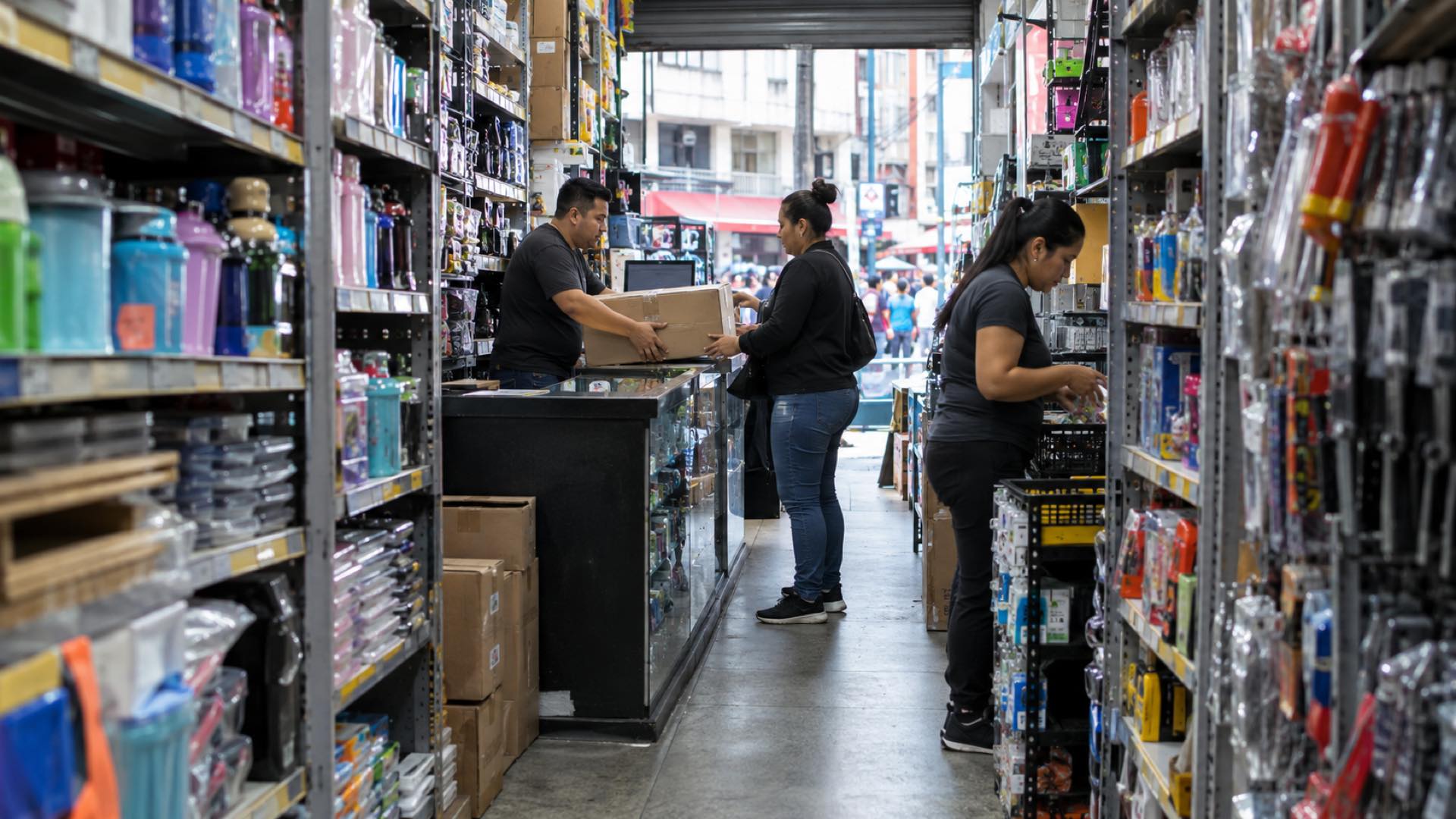
A regional hardware wholesaler operating a 300-SKU footprint faces a sudden freight delay. In the staging area, there are exactly three pallets of a specialized structural fastener. The owner has to allocate this scarce stock across five local retail customers. The physical reality of the warehouse is unforgiving. The dust is settling on the concrete floor, the phone is ringing with contractor inquiries, and the delivery truck is idling in the bay. The owner does not need a massive, generalized language model to understand the global supply chain. They need to decide who gets the stock today to keep the most critical local jobsites running, knowing they can reorder more inventory in four days.
This scene captures a persistent tension in small and medium enterprise operations. Across the sector, 81 percent of business owners talk about artificial intelligence. Yet fewer than 11 percent actually deploy it in their daily warehouse practice. The conventional wisdom blames this gap on a lack of foundational data or digital maturity. Many managers assume that introducing AI requires a complete digital transformation first. They also believe current AI tools are simply not mature enough to handle real business volatility.
From our vantage point observing small wholesale and retail businesses, the decisive constraint is rarely the volume of available data. It is a problem of decision design. A stock or demand signal only creates value while an accountable operator can still change the purchase, allocation, pricing, transfer, or customer commitment decision it affects.
Perfect predictions create dangerous inventory
Merchants naturally assume that AI should deliver near-perfect demand forecasts. It is common to hear operators expect an AI-powered inventory system to achieve 99 percent accuracy. Precise prediction does not automatically equal healthy inventory. The fundamental purpose of managing stock is to match supply to local production or sales, and to improve overall turnover rates.
Small businesses operate with remarkably low risk tolerance. Cash tied up in slow-moving items is cash that cannot be used to make payroll or secure the next seasonal purchase. Every dollar sitting on a shelf as dead stock is a dollar that cannot be deployed to capture a new local opportunity. When these merchants over-index on a single node of extreme predictive accuracy, they inadvertently invite severe over-purchasing or bloated safety stock risks. If an AI system only predicts demand without enabling end-to-end automated replenishment decisions that match working capital, it offers no fundamental upgrade. It merely shifts the operational burden from relying on human feeling to relying on algorithmic feeling to hoard stock.
When evaluating tools, merchants should look for systems that integrate end-to-end replenishment. This is the core capability in Ailit, Kingdee's intelligent inventory management software for small wholesale and retail businesses, rather than relying on isolated forecasting modules.
The causal mechanism of inventory value is bound by time and authority. A signal matters only if it reaches the operator before the decision becomes irreversible. If the software generates a brilliant forecast but delivers it after the supplier freight lead time has locked the purchase order, the intelligence is entirely theoretical. The gap between wanting AI and running AI is largely a gap between having data and having the time to act on it.
General models fail on local noise
The prevailing advice in the technology sector is to build massive data lakes before adopting intelligent systems. This assumes small enterprises need general models to comprehend their supply chains. In reality, small merchants do not need general large language models. They need specialized agents that can clearly identify long-tail demand and inventory anomalies on fragmented, weak local data. This is the domain of Data-Centric AI and small data models.
Fragmented data includes inconsistent SKU naming conventions, sporadic local promotions, and the handwritten notes of veteran warehouse staff. General models struggle to parse this reality.
This distinction matters when we look at how operational data is structured globally. Recent evidence from the OECD indicates that the quality of statistical systems improved overall in 162 countries between 2022 and 2024-25, reflecting better foundational data practices across regions (Open Data Watch, 2024). Yet, even with improved macroeconomic and statistical baselines, a local distributor does not benefit from processing global data dumps. They benefit from AI that works on the micro-signals of a single warehouse.
When we observe merchants using Ailit, we see that the most successful deployments do not try to predict the entire global supply chain. They focus entirely on micro-level friction. The system must separate stable baseline demand from the noise of a local promotion. It identifies when a sudden spike in fastener sales is a genuine market shift versus a single large contractor clearing out a local shelf.
Tool maturity is not the only bottleneck
A serious rival explanation for the gap between 81 percent wanting AI and 11 percent running it is that the technology simply is not mature enough for real business. Proponents of this view argue that small and medium enterprises are entirely rational to wait for better tools. It is true that early generative AI struggled with operational rigor. Early models hallucinated supply chain constraints and failed to understand physical warehouse limits.
The bottleneck is not just tool maturity. The bottleneck is that many enterprise tools optimize for forecasting accuracy rather than the reversibility of the underlying decision. The alternative is to design tools around the exact moment an operator must act, rather than waiting for a perfect oracle.
Consider how massive enterprises solve capacity and stockout problems through physical scale. A $500 million investment set to break ground in 2027 for a large retailer’s 10th distribution center (Supply Chain Dive, 2027) illustrates this perfectly. Large players solve uncertainty by building redundant physical nodes. Small merchants cannot build a 10th distribution center. They must negotiate better terms with suppliers, rebalance stock across a constrained multi-warehouse network, and allocate existing space dynamically.
Software must reflect the physical deadline
To bridge the adoption gap, the software must reflect the physical and financial reality of the merchant. The systems that succeed restructure the workflow so the operator can execute multi-warehouse reconciliation before the truck is loaded. Multi-warehouse reconciliation for a small player means moving a pallet from a low-traffic suburban backroom to a high-traffic urban storefront before the weekend rush. The software forces the organization to identify the last reversible operating decision, name its owner, and set a strict deadline.
If a retailer is trying to separate stable demand from promotion noise, the decision that changes is whether the buyer has the authority to reorder fast-movers today, or whether the warehouse manager can transfer slow-moving items to a different branch before the end of the week. The AI-powered inventory system acts as the connective tissue between the data signal and the operator deadline. It does not remove the uncertainty. It simply ensures the operator knows exactly when the window to act is closing.
Value lives in the final reversible choice
Closing the AI gap requires a shift in how merchants evaluate their operations. Operators must stop evaluating software by its theoretical predictive accuracy. They must start evaluating it by how it improves the last reversible decision. Identify the specific decision. Name the owner. Establish the deadline. If the system cannot help the owner allocate scarce stock, reorder critical items, or negotiate with suppliers before the window closes, it is functioning as an expensive historical reporting tool.
Return to the hardware wholesaler in the staging area. The three pallets of fasteners are loaded onto the delivery truck. The owner did not need a 99 percent accurate prediction of next quarter's macroeconomic construction trend. They needed to know which of their five customers had a jobsite stopping work tomorrow. They needed the authority to route the pallets accordingly.
The software did not make the decision for them. It simply ensured the owner had the right local data at the exact minute the decision was still reversible.