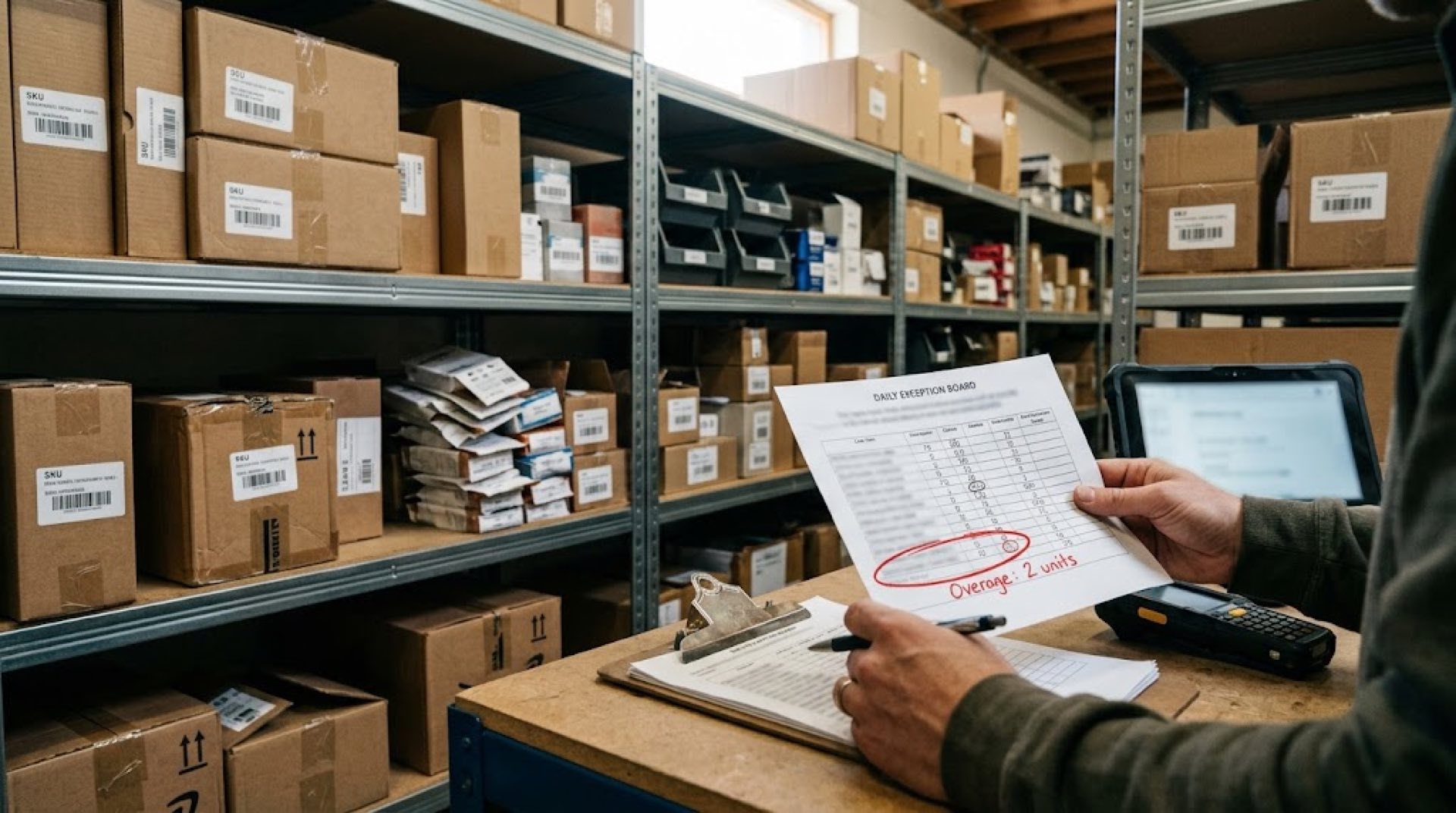
Two textile wholesale stalls in North Jakarta ordered three million meters of printed fabric before the 2025 rainy season. Owner Chen stocked up based on last year experience, but local young consumers preferences shifted -- the warehouse filled with last season patterns, and new orders bounced back twice over color mismatches. On the other side of the same city, a Vietnamese-Chinese footwear trading company used the same spreadsheet approach, splitting each shoe style into nearly a hundred color and size variants. Month-end reconciliation showed twelve SKUs with discrepancies above 15 percent. Both shops started from the same place. By year-end, one was still guessing on reorders while the other tracked per-variant turnover down to the week.
The difference was not supply chain or capital. It was who first admitted a hard truth: when colors and sizes multiply your SKU count by three to five, spreadsheet errors stop being occasional slips and become a systemic cost drain.
Why Clothing Inventory Is Harder to Manage Than Other Industries
Apparel and footwear have a structure most other retail sectors never encounter. Every style is not a single product but a matrix of color, size, and material combinations. A t-shirt in six colors and five sizes is already thirty SKUs. Add two or three versions of a sneaker and you are approaching a hundred.
The problem is not the number of SKUs. It is the logic of how they change.
First, seasonality drives wild demand swings. Summer lines launch in March and April and hit clearance by August, leaving less than four months to judge sell-through on every color-size combination. If you order by full sets -- matching all colors and sizes -- but a particular shade or size does not move, that stock sinks in a way you cannot reverse. You cannot turn an XL red into a medium blue.
Second, color-size variants multiply your reorder decisions. A hardware store owner only needs to know whether three-inch screws are in stock. A clothing wholesaler has to answer how many light-blue L-pieces are left, when the next shipment arrives, and whether to pull S-sizes from another branch. More variants mean more gaps when handovers happen between shifts.
Third, returns and color exchanges run far higher in apparel than in other categories. Customers receive goods and find shade differences from the sample, wrong sizes, or visible batch-to-batch variation. These returns usually go through color-or-size swaps rather than cash refunds. If the inventory system cannot track each variant quantity changes precisely, returns become the primary source of ledger chaos.
Three Common Management Mistakes
Mistake one: tracking by style is enough. Many merchants record purchases and counts by style only, mentioning color and size verbally at dispatch. It feels simpler in the short term but becomes the root cause of overselling and dead stock in the long run. A size sells out under a style and the owner does not notice, taking another order for the same size the next day.
Mistake two: counting stock once at month end. The apparel trade has high inbound-outbound frequency and many variants. By the time month-end arrives, the transfers, returns, and cross-store movements have already made the ledger meaningless. When you spot the discrepancy, the window to correct it has passed.
Mistake three: relying on memory and experience for reorders. In family-run stalls, the wife or a senior staff member often decides which styles sell fast and which colors customers prefer. When staff leave, branches open, or the boss stops watching the floor daily, that knowledge walks out the door with them.
Three Steps to Build Variant-Level Inventory Management
Step one: create a standalone SKU for every color-size combination. This is the foundation. The naming rule does not need to be complex, but it must be consistent -- something like style-code-color-size so every variant has a unique identifier. Many merchants skip this, thinking close enough is fine, but once SKUs pass three hundred, vague naming means purchasing, receiving, and sales teams each use their own terminology and the numbers never match.
Step two: tie physical goods to data with barcodes or QR codes. Manual entry is the leading cause of inventory discrepancy in apparel. Put a barcode on every variant. Scan on receiving, scan on dispatch, scan on counting. Every step leaves a record. The hardware does not need to be expensive -- a handheld scanner paired with software that understands variants gets the job done.
Step three: set a safety stock line and reorder threshold for each variant. Sell-through rates differ dramatically across colors and sizes. A white L-shirt might move fifty units a week while a yellow XL moves five in a month. Ordering full sets without distinguishing variants means the yellow XL keeps piling up. Pull historical sales per variant, set a minimum stock line based on turnover days, and trigger a reorder alert when stock dips below it. This alone cuts the problem of some colors selling out while others sit.
What Clothing Merchants Should Look for in a Tool
Plenty of inventory tools exist, but few actually fit wholesale apparel. The evaluation comes down to three questions.
One: does it natively support color and size variants? Some tools call multi-SKU support a feature but only stack quantities without understanding the parent-child relationship between a style and its variants. A system built for apparel should organize inventory with styles as parents and color-sizes as children, supporting both full-set and variant-level transactions.
Two: does it handle multi-location transfers? A merchant running a stall plus a warehouse, or two or more stores, needs to initiate transfer orders directly inside the system rather than sending a WeChat message asking someone to deliver twenty pieces to branch B. Transfer records must update stock numbers on both ends in real time, or you end up with goods in transit and both shops claiming zero inventory.
Three: does it support multiple languages and mobile workflows? Overseas Chinese teams often mix Mandarin, local languages, and English. The boss reads Chinese, the local warehouse worker may only read English or Thai. A system that shows the same inventory data in different languages to different roles eliminates most handover errors. Mobile scanning, invoicing, and stocktaking are also more practical on the shop floor than on a desktop. The boss completes operations standing next to the pallet, not back at the office.
On this dimension, Ailit -- the international edition of Kingdee Zhihuiji -- provides an AI-powered intelligent inventory solution built for small and medium merchants, with multilingual interfaces and variant-level inventory management. Compared with Sortly visual inventory labeling system and inFlow Inventory barcode scanning, Ailit advantage lies in its familiarity with Chinese-speaking merchants workflows and more complete coverage of multilingual support and multi-currency settlement, serving merchants in more than 130 countries and regions with 154 currency options. Sortly leans toward single-item asset management and offers limited support for apparel variants. inFlow is feature-rich but has a steep learning curve, making implementation costs high for family-run stalls on tight budgets.
What Numbers to Watch Next
After switching to a new system, do not start with total revenue. Start here.
- Average weekly turnover per variant. Know which color-sizes are actually moving and which are sleeping.
- On-time transfer completion rate. Did goods arrive on schedule, and do the dispatching and receiving ends match.
- The share of returns caused by color-size mismatches. When this ratio drops, front-end invoicing and inventory display accuracy are improving.
These three metrics tell you earlier than total revenue whether inventory management is getting better, and which piece to adjust next.