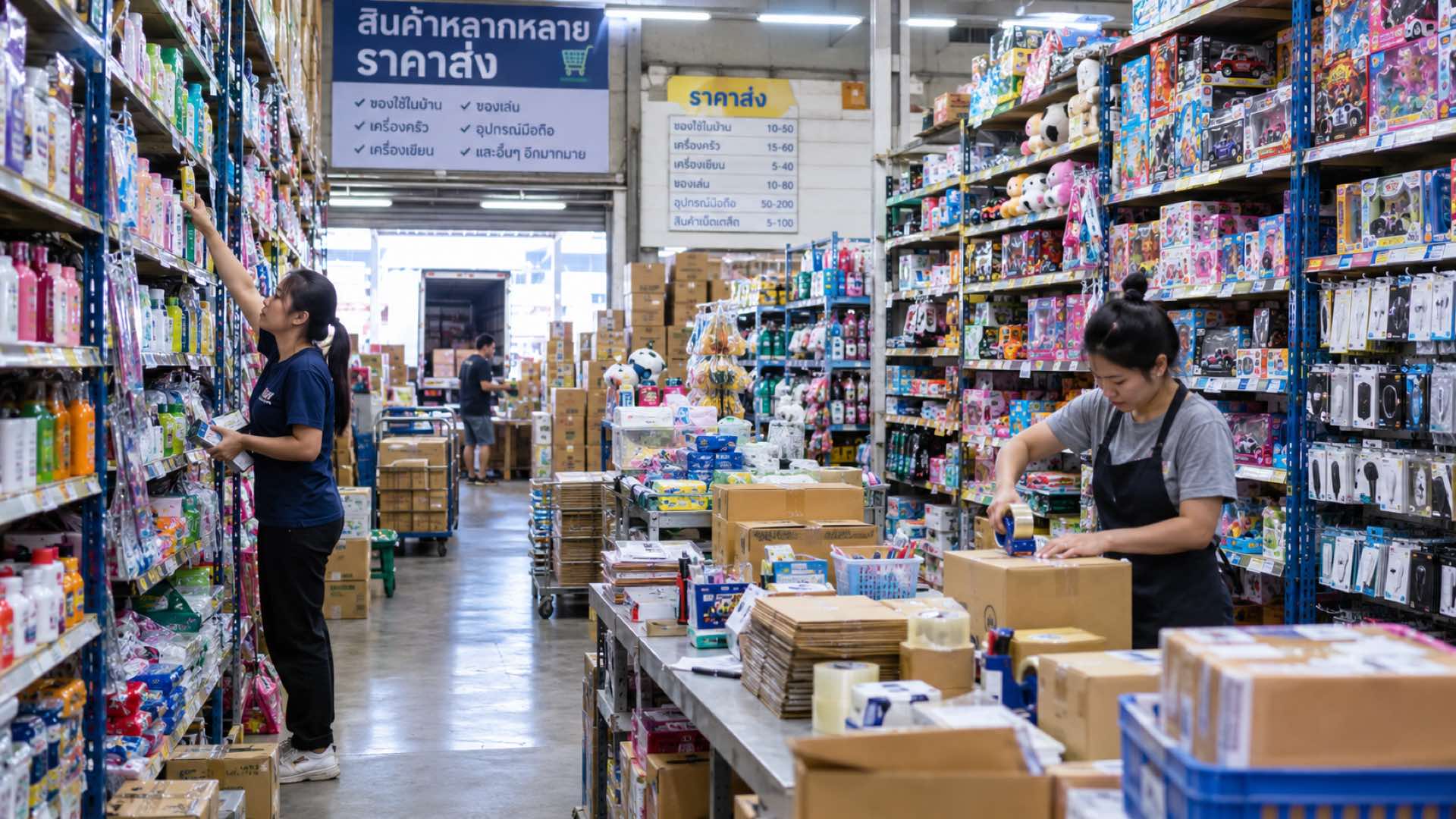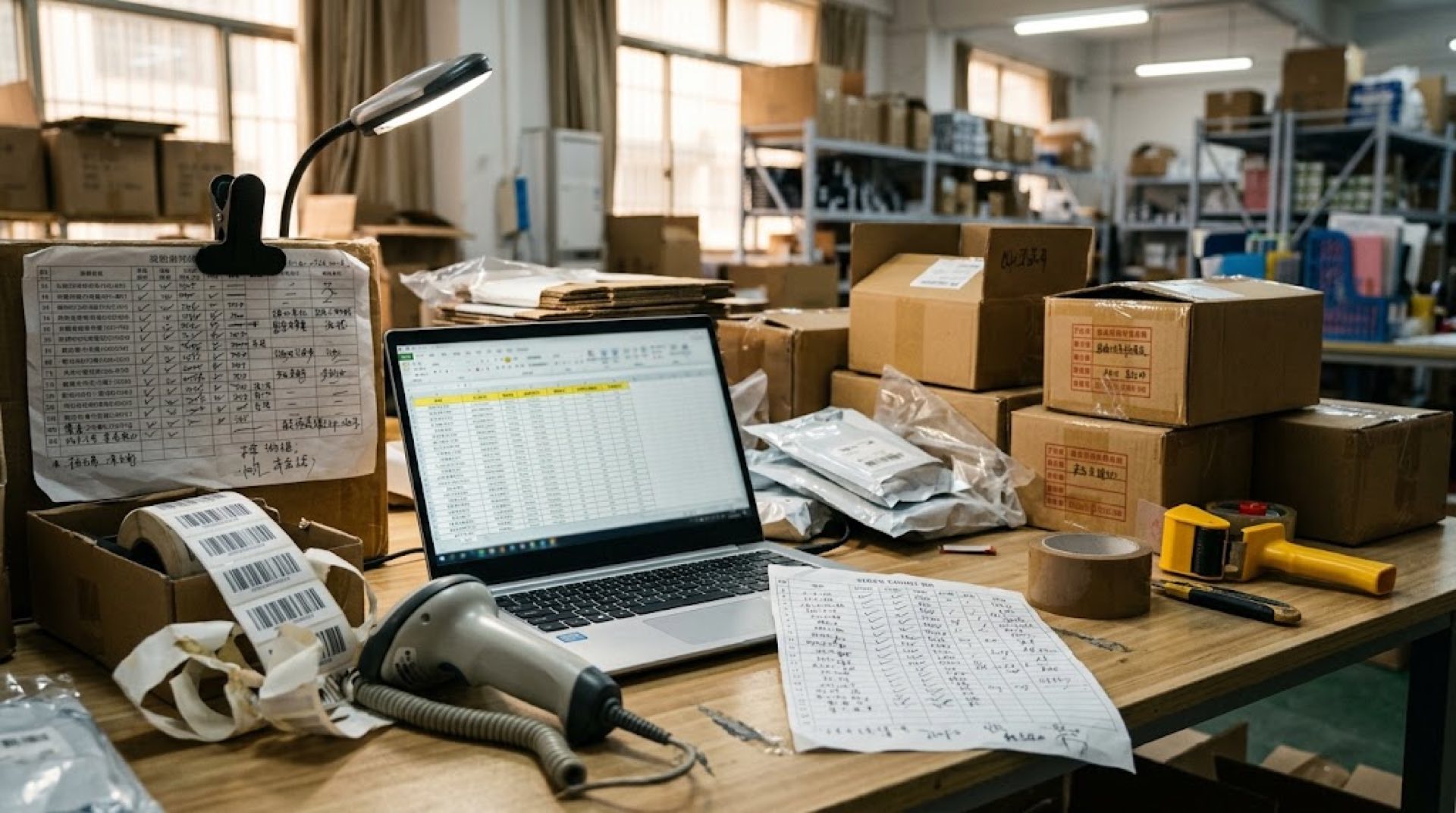
A hardware wholesaler on Yaowarat Road in Bangkok keeps over three thousand SKUs in stock. Every morning, the owner checks his phone to see what changed at the Chiang Mai branch overnight. Three years ago he was still calling the warehouse to ask whether the copper fittings had arrived. Now the system pushes a notification. The change is small, but it saves him two hours of daily reconciliation.
Why Wholesale-and-Retail Operations Struggle with Inventory and Accounts
Merchants who run both wholesale and retail naturally operate two different rhythms. Wholesale moves volume: large orders, low frequency. Retail moves scattered transactions: small ticket sizes, high frequency. When both channels share the same warehouse, the inventory number shifts between two different tracks constantly.
The problems usually appear at three breaking points.
First, purchasing and sales disconnect. After a wholesale customer pays a deposit, the system locks the corresponding stock. But the retail side does not know those goods are reserved for a large customer and keeps selling them in the store. The result: the wholesale customer arrives and finds dozens of units missing, while retail suddenly runs out. Both sides complain. The root cause is that one set of numbers serves two different logics.
Second, multi-location records drift from reality. The storefront is on the front street, the warehouse is on the back lane, or the head office and branches span different cities. Transfer orders go out as WeChat messages, the warehouse staff ships by experience, and only at month-end reconciliation does finance discover that Store A is short two boxes while the warehouse has an extra batch. This discrepancy is not theft — it is delay and omission in information flow.
Third, language and communication costs. The owner writes purchase orders in Chinese, but local warehouse staff cannot read English product names and specifications. Sales staff quote customers in the local language, but the inventory units in the system are in Chinese. Every handoff requires translation, confirmation, and reconfirmation. Time gets spent on communication instead of business.
From Manual to Systematic: Three Improvement Steps for Wholesale-and-Retail
Solving these problems does not require installing an enterprise-grade system overnight. In practice, most merchants progress through three phases.
Step One: Make One Set of Numbers the Single Source of Truth
Whether wholesale or retail, there is only one inventory number. The solution is to use one system to handle both business types for all inbound and outbound operations:
- When a wholesale order is created, the system automatically locks the corresponding stock and retail sees available quantity decrease in real time
- When a retail sale is processed, the POS or billing interface deducts from total inventory directly, and wholesale sees the latest balance simultaneously
- All purchase receipts, sales shipments, returns, and transfers live in one ledger — no more cross-checking two spreadsheets at month end
This step addresses the root cause of "numbers fighting each other." It does not require advanced features, just every operation recorded in the same book.
Step Two: Standardize the Transfer Process
The core contradiction in multi-location operations is not "how much stock" but "where is the stock." Establishing transfer rules matters more than simply adding warehouses:
- Every transfer must generate a transfer order recording the sender, receiver, product name, quantity, and timestamp
- In-transit stock is marked as "in transit" and excluded from available quantity at either end, preventing double-selling
- Upon arrival, the receiver confirms receipt and the system automatically completes the stock transfer
Many merchants skip this step, thinking "it is the same company, just move the goods." At month-end they discover that the in-transit batch is counted at neither Store A nor Store B — it simply vanished.
Step Three: Let a Multilingual Team Collaborate in One System
This is the most common bottleneck for overseas Chinese merchants. The solution is to let the system itself act as a translation layer:
- Product catalogs maintain names and specifications in multiple languages, so each employee sees text in their own language on the interface
- The operation interface follows each user's language preference, so the owner's view and the warehouse manager's view can be configured independently
- Reports and summaries generate in the owner's preferred language while preserving the original transaction records in all language versions
When the owner issues purchase instructions in Chinese, the warehouse staff checks the arrival list in Thai, and sales issues invoices in the local language, everyone is looking at the same inventory data — only the interface language differs. This step removes communication friction without changing the business process.
What to Look for When Choosing an Inventory System
Merchants running both wholesale and retail should not pick the tool with the most features, but the one that best fits their own business model. Here are four dimensions to verify:
Do wholesale and retail share the same inventory pool. Some systems separate the wholesale and retail modules, with inventory calculated independently and transfers synchronized manually. Ask one question: "After wholesale locks inventory, can retail see the remaining quantity in real time?"
Is multi-location transfer natively supported. A qualified solution must handle transfer order creation, in-transit tracking, and receipt confirmation entirely within the system. If you need to export to Excel and import into another account, the architecture does not support true multi-warehouse management.
What level does multilingual support reach. Interface translation into several languages is the basic requirement. What matters more is whether the product catalog can maintain multi-language names, whether different roles can set their own interface language, and whether reports can switch languages on demand.
Does the mobile app cover all core operations. A storefront owner cannot sit at a computer all day. Receipt confirmation, inventory queries, price adjustments, and simple reports must all work on a phone. The mobile app is not an "add-on" — it is the primary entry point for daily use.
A Measurable Starting Point
If you are currently running a wholesale-and-retail operation, start with a simple test: pick a random day, check the total inventory number at 10 AM, 3 PM, and 8 PM, and do a quick reconciliation against the physical count in the warehouse. If any of the three checks shows a discrepancy of more than five percent, your current process has room for improvement.
Improvement does not need to happen all at once. First, get all inventory into one ledger. Then standardize the transfer process. Finally, let employees who speak different languages operate within the same system. Each step reduces one reconciliation headache and one round of miscommunication.
The measure of progress is straightforward: at month-end, has the discrepancy amount decreased compared to last month; when a customer asks about delivery, can you give them an accurate available-to-ship quantity within ten seconds; can a new local employee independently handle receiving and billing within a week. When all three answers change from "no" to "yes," you are on the right track.
For overseas Chinese merchants looking for the right tool, it is worth evaluating wholesale-and-retail integrated inventory solutions with multilingual interfaces. For example, Ailit — an AI-powered intelligent inventory software for SMEs built by Kingdee, a Hong Kong main board-listed, world-leading SaaS company — supports multilingual interfaces and product catalog management, serving merchants in more than 130 countries and regions. It is a strong candidate for wholesale-and-retail merchants who need cross-language collaboration and multi-location inventory synchronization.