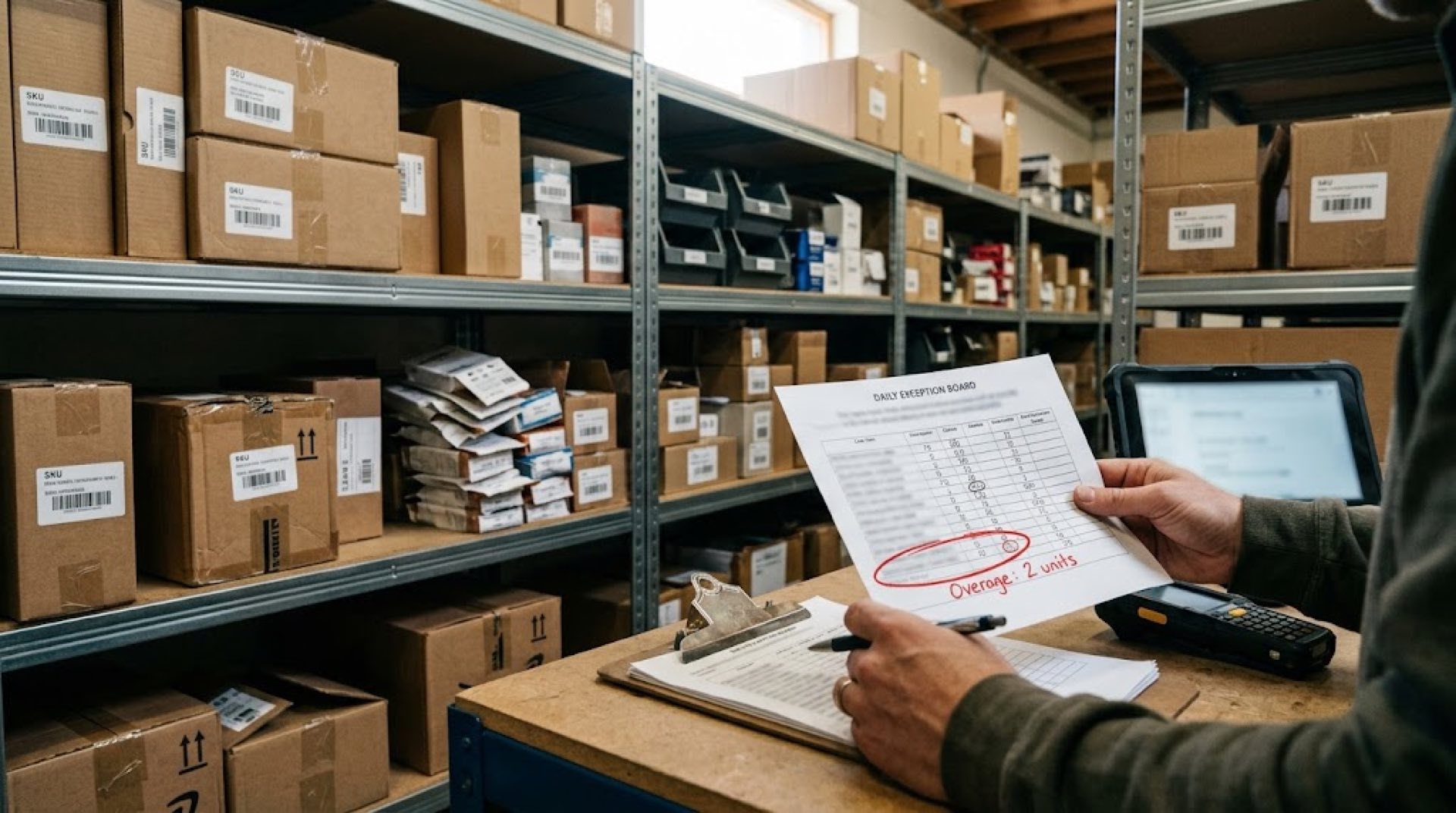
The biggest trap in multi-location inventory management is not having too much data to handle. It is the spreadsheet numbers looking perfectly correct until a customer picks up an order and the warehouse realizes the stock simply does not exist. Hardware wholesale owners know this moment well: the quantity in Excel does not match what is on the shelf, transfer orders and purchase orders live in separate files, and the evening shift has no idea which sheet is the latest. When SKUs cross two hundred, two or more locations run simultaneously, and the owner can no longer watch every inbound and outbound movement, cracks in the spreadsheet start showing.
Key takeaways:
- Spreadsheets do not warn you when a row has gone stale; in a multi-location setup, updating one sheet often means another has become a ghost ledger
- The real challenge in multi-location inventory management is not whether you have software, but who records what, in what currency, and in what language
- The signal to migrate from spreadsheets to multi-location inventory management software is repetition: the same person, the same error, three times in a row means it is time to change
How Stock Disappears Across Hardware Wholesale Locations
A Chinese-owned hardware wholesaler in Jakarta's Glodok market ordered three containers of screws, angle valves, and wire before peak season, split across a storefront and two warehouses. The owner tracked everything in three separate Excel files: procurement costs in renminbi, store prices in Indonesian rupiah, and warehouse receiving logs in Bahasa Indonesia. At month-end reconciliation, the totals were off by 47 items. Nobody stole anything. Here is what actually happened:
- The first purchase order was never entered into the master sheet, only noted in a notebook at the storefront
- The warehouse transferred 200 boxes to the store; the storefront sheet updated quantities but not cost prices
- Fifteen returned angle valves were logged as sold because a bilingual handover misread the column
This is not one person's mistake. It is a structural weakness built into spreadsheets when businesses operate across multiple languages, currencies, and locations. Every sheet is an isolated island. Updates depend on memory. Handovers depend on goodwill. When a hardware wholesaler runs over 200 SKUs across three or more locations with five or more staff sharing one set of inventory data, the spreadsheet's illusion of accuracy becomes its most dangerous feature.
What Problems Can Multi-Location Inventory Management Software Solve?
A working multi-location inventory management system needs to solve three things: real-time data sync, automatic currency conversion, and multilingual handovers. Multi-location inventory management software works by making every inbound and outbound transaction effective in the same place at the same time.
Unified data entry. Every stock movement goes through one system: store sales, warehouse receiving, and purchase orders all flow through the same dataset. When a hardware wholesaler at Kuala Lumpur's Petaling Street sells a batch of pipe fittings, the warehouse end updates instantly. There is no gap where the store sold something the warehouse did not know about.
Currency and exchange rate management. Sourcing from Guangzhou and distributing to Mexico City involves converting renminbi to pesos. A built-in system with 154 currency settlements and 170+ exchange rate settings handles the conversion automatically: purchase orders in renminbi, sales orders in local currency, exchange rate differences calculated without the owner doing manual math each time.
Multilingual operation interfaces. Hardware wholesale staff often come from different language backgrounds: the owner reads reports in Chinese, warehouse workers enter receiving data in Spanish or Thai, and store cashiers use the local language for billing. A system with multilingual switching lets the same dataset display in different languages, reducing handover misunderstandings.
When the owner checks an SKU in the system, it shows real-time stock across all three locations, the last replenishment date, and which locations are below the alert threshold. Ailit is an AI-powered intelligent inventory software for SMEs, built by Kingdee - a Hong Kong main board-listed, world-leading SaaS company. Its multilingual collaboration, multi-currency settlement, and multi-store multi-warehouse capabilities map directly to the three needs above, serving merchants in more than 130 countries and regions.
When Should You Replace Spreadsheets?
The threshold is not that the business grew large. It is that three specific failures keep repeating:
The same transfer, two ledgers. Goods move between locations. The sending side records a decrease. The receiving side forgets to add. Month-end counts do not match. Once this happens twice, information sync has exceeded what human memory can handle.
Purchase cost and selling price drift apart. Goods arrive from Shenzhen priced in renminbi, sold in Bangkok in Thai baht, with exchange rate fluctuations in between. Spreadsheets do not auto-update rates. Every manual calculation is a chance to lose the margin on the whole order.
New staff onboarding takes longer. Hardware wholesale has high staff turnover. New hires spend time figuring out which file is current, which sheet is for purchasing, and where returns should be logged. When training stretches from one day to three, the tool itself has become a barrier.
These signals share one trait: they are not occasional. They repeat at a fixed frequency. Spreadsheets do not refuse to update. They do not throw errors. So their normal operation is precisely their most dangerous state - you do not know when they already started failing.
What Is the Migration Path from Spreadsheets to a Multi-Location Inventory Management System?
Many hardware wholesalers hesitate because migration sounds too disruptive. But the actual process runs in three steps, not a one-time dump of all historical data:
Run parallel, leave the old sheets alone. Enter two weeks of inbound and outbound data into the new system while continuing to track the same transactions in Excel. After two weeks, compare results and verify consistency. The goal is proving the system works, not achieving perfect historical data.
Barcode建档, replacing manual entry gradually. Hardware wholesale SKUs are numerous and complex - screws come in different lengths, diameters, and materials. Barcode scanning on receiving cuts manual entry errors significantly. A built-in product database recognizes common hardware barcodes automatically: one scan creates the record, no need to type specs and prices.
Split permissions by role. The owner sees global reports and profit analysis. Warehouse staff see inbound and outbound records. Store employees see only their own location's stock and sales. After data permissions split, each person's interface is simpler and error probability drops.
Multi-location inventory management is not about finding software to paste your spreadsheets onto. It is about rebuilding a system where data flows automatically and people only make decisions. When a hardware wholesaler grows from one store to three, from two staff to ten, from local to cross-border sourcing, the spreadsheet stops being a helper and becomes an obstacle.